‘...The imperfect story of these volumes...’
A long time ago, when I was pretending to work towards my master’s degree, I came across Jourdain’s history of the Connaught Rangers: two hefty cloth-bound volumes, showing their age but otherwise in good nick, because, to be fair, who’d be bothered to take them off the shelf?
I was bothered, because I’d take any excuse to dodge my own work and because I’d just read all the Sharpe books. The Connaught Rangers; the 88th Foot; the Devil’s Own – this book was the fountainhead, the primary source, the straight dope.
So it may have been, but it was also unforgivably dull.
I’d come for the fear and fire and blood of Badajoz and the book gave me little more than a casualty report and a brief note of pride. That’s the way with almost all the regimental histories: if you want drama, bring your imagination, because these works were all written by middle-aged officers in the 1920s and stiff-upper-lippery was the accepted tone. A bloody victory? Well done. A brigade football trophy? Well done.
You might also need some appreciation of regimental structure if you don’t want be put off right away. So in those distant pre-internet days, when I clung to the sole fact that the wild hooligans of the Connaught Rangers had been the 88th Foot, I was thrown by a large part of their history being devoted to some other regiment numbered 94 and coming from Scotland. Forget it. I went back to the field I’d been shirking.
By the time I tackled the Munster Fusiliers many years later I had a better grasp of things, and I was braced for the ponderousness of the histories of the disbanded Irish regiments.
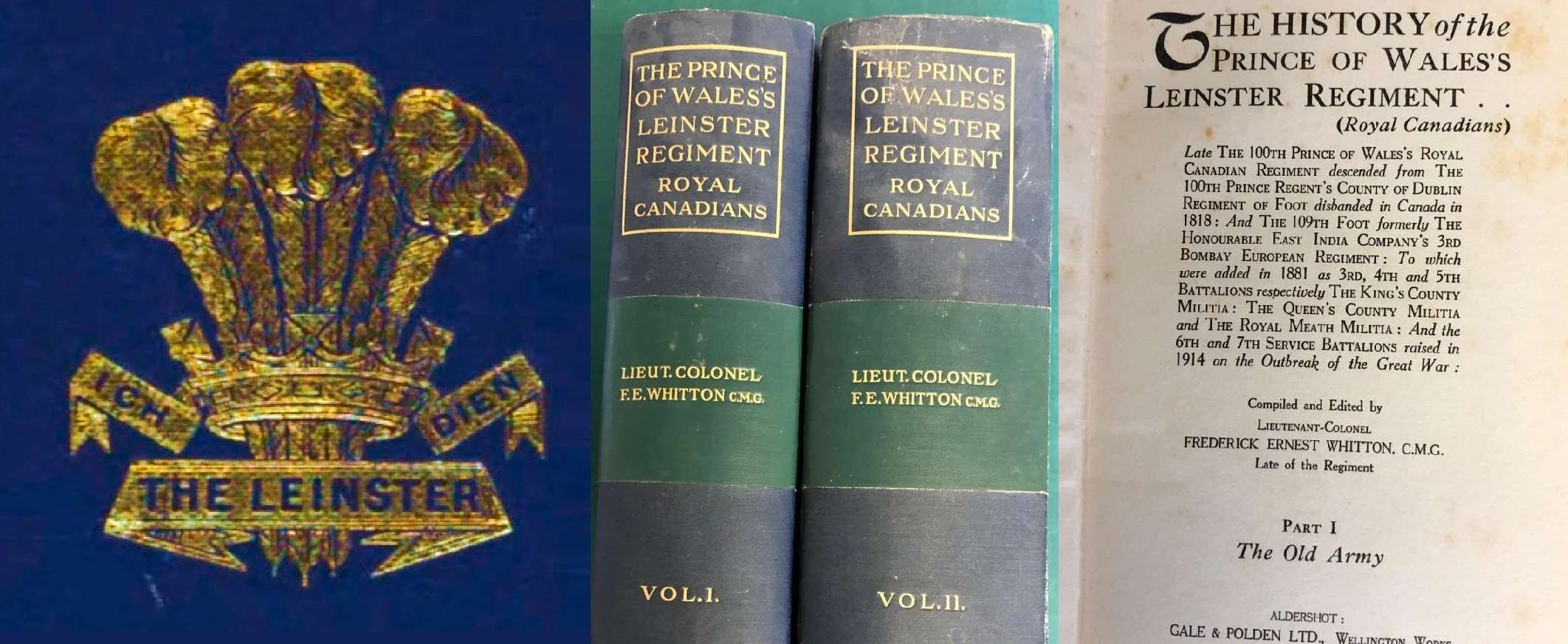
And then I found Colonel Frederick Ernest Whitton of the Leinsters and everything became brighter. (The opening quote is his, by the way, and it does him an injustice.)
Whitton had a sense of humour and knew how to tell a good story. He could even humanise the whole confusing business of the 1881 localisations and amalgamations (which was how the 94th Scottish ended up as part of the Connaught Rangers, in case you were worried). It was delightful – if you like that sort of thing. I was only sorry that my Munsters didn’t have so eccentric an origin.
The Munsters (as I hope you know by now) were descended from a Bengal regiment which split into two, was absorbed into the British army, and then re-amalgamated and designated as Irish – which made sense, given the high proportion of Irishmen who’d soldiered for the East India Company back in the day. For the Leinsters it wasn’t so logical.
The Leinster Regiment began as the 100th Foot, raised in Canada for service in the Crimea. They never got there, and this disappointment, along with the tedious kerfuffles of peacetime soldiering, drew off many of the original recruits and discouraged further Canadian enlistment. The Canadian element of the regiment quickly declined, and soon the distinction of the 100th wasn’t that they’d originated in Quebec, but that the Prince of Wales had favoured them with his title. And then one day in 1881 they were told that they would henceforth be Irish and that their home would be Birr, County Offaly. Their objections were loud. How could they possibly be Irish, they protested, when they were as Canadian as Canadian could be? It availed them nothing, beyond the right to add their old association to their new name, clumsily called hereafter The Prince of Wales’s Leinster Regiment (The Royal Canadians).
Old and pointless loyalties die hard. Thirty-five years later it was wondered why men of the Irish Division in Macedonia were sporting a shamrock in red on their sun helmets. It was, of course, a maple leaf.
The regiment that became the 2nd Battalion accepted their transformation in 1881 without fuss, but that’s possibly because they’d already been through so many changes – and possibly because they were German.
They’d also been recruited for the Crimean War and, unwilling or unable to return home afterwards, many accepted the offer to settle in South Africa as a colonial militia. Barely had they set up home on the veldt when the Indian army needed bolstering against the great uprising of 1857, and that’s how the 3rd Bombay Europeans became filled with Germans and Austrians from South Africa, shortly before it was folded into the British army proper as the 109th Regiment of Foot. After all that, it was hardly any great upheaval to amalgamate with the Canadians and march to the tune of ‘Come Back To Erin’.
(This is the sort of thing that made me fall in love with regimental history, and why Dirty Shirt is how it is.)
Frederick Whitton recounts the story as if he’d been there to see it all.
Read his description of the deaths and disappointments in Jullundur in 1878 to which ‘we were daily witnesses’, and it takes a moment’s calculation before you work out that he couldn’t have been there. He can only have been a small boy in England at the time, just as he wouldn’t even have been born when ‘we’ were stationed in Gibraltar twenty years earlier.
But the immediacy is justified. The regiment is always ‘we’. Its life was his, and thus so was its history.
And there are more reasons to be charmed by Whitton.
Anyone can liven up the plain record with a little colour. Any history worth its salt can furnish the heat and dust, the blood and sweat. But there aren’t many to give us the likes of this:
In those days of Form a correct and suitable kit had to be evolved for this new pastime. Anxious deliberation eventually fixed on a Norfolk jacket, knickerbockers, riding leggings and above all things a hunting stock, immaculately white, exquisitely tied and with gold safety-pin complete.
That, my friends, is the approved dress for an officer taking up the once radical and suddenly respectable pursuit of bicycling, Aldershot 1896. I don’t know about you, but that’s the kind of thing I want from my history.
Alas, Captain McCance’s history of the Munsters never attempts that sort of human interest, nor did I find such joys in Jourdain’s history of the Connaught Rangers when I discovered it in the library all those years ago.
I was never as much of a scholar as I made myself out. I wanted the anecdotes. I wanted the pen-pictures. Maybe that’s why I put Jourdain back on the shelf, and maybe that’s why – as soon as I wound up my master’s – I headed for the door, leaving history behind me for twenty years.