A good long way from Cork
Get off the tram at Pazartekke or, if you don’t mind navigating the looping overpasses and tunnels, you can hang on until the next stop. It doesn’t matter. Roughly midway between the two you’ll find what you came for. Can’t miss it. It’s been the most conspicuous thing here for the past sixteen centuries, give or take.
I could be flat wrong about this, and that could be down to patchy memory on my part or numerous wayward historical traditions, but the place at which I discovered my travel card needed topping up was roughly where the Roman empire came to an end.
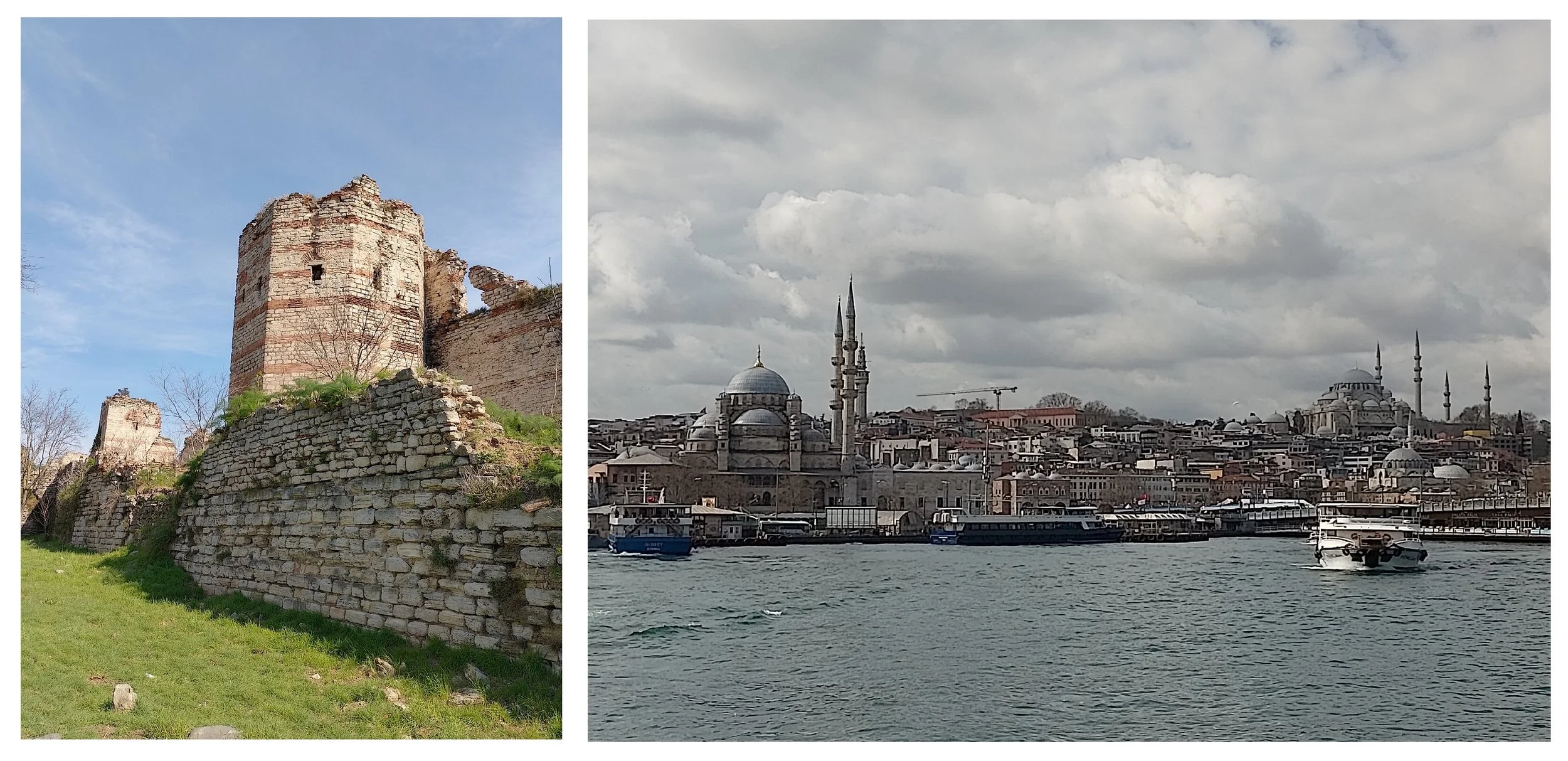
Holiday snaps courtesy of the author.
Here, or hereabouts, Constantine XI went down fighting. Maybe. I am much surer about the where and how of something else that marked the momentous event. There, equidistant from the two tram stops, is where the Turks broke through the walls of Constantinople in May of 1453. You can’t tell me I’m wrong about that. The walls are still there with a great big gap in them, and it’s not like the gap was made to accommodate the dual carriageway and tram line. You bet I was impressed. It was for this sort of thing that I’d submitted to early rising and long bus journeys and stooging around airports and cramming myself into too-small seating for fourteen hours the day before. It was a marvel to stand in the open, under green trees and blue skies, with the Theodosian wall looming over me, close enough to touch.
And to add to the moment, as I was wandering up and down with my mouth open, musing on the triumph of Islam, the call to prayer rang out. I’d never heard it before. The name of God, in strident chant, blasting out from the powerful PA system atop the nearest minaret, and taken up by every other minaret within earshot, reminded this one gormless infidel tourist who it was owned this city now.
I had three more days of this sort of thing. Three days fuelled by little honeyed cakes and tiny cups of sludgy coffee. Sights of gobsmacking historical and cultural significance are not wanting. The geography itself impresses. This is a place where the same travel card that took you a few stops on the metro or tram will also take you to the next continent and back. How often does public transport afford you a view of palaces and mosques, while all the world’s shipping comes into sight on your starboard quarter and a school of porpoises swims across your wake?
This – to drag things into the orbit of Dirty Shirt – is where the Munster Fusiliers were ultimately heading when they came ashore at Seddülbahir a hundred and eleven years ago next month. You don’t know the story?
When the Turks came into the war in 1914 the British and French were determined to knock them right out again. French and British warships were to steam up to Constantinople, level their guns at the Topkapi Palace and other such places that were wowing me last week, and that would be that. Johnny Turk would cave, the Ottoman Empire would be taken off the board, and Constantinople would be handed over to the Russians to keep them happy.
It turned out that the navies weren’t up to the job of forcing the Dardanelles straits, so troops were landed to deal with the Turkish fortifications.
Among the first ashore were the Dublins, Munsters and Hampshires. Look up Seddülbahir or Sedd el Bahr or Cape Helles and you’ll quickly find that one photo of them sheltering beneath the gunwales of the boats that didn’t quite get them to the beach. The photo is in monochrome, with springtime Aegean colours all rendered in grey, but on that morning aerial reconnaissance reported that for fifty yards offshore the sea was red with blood.
I’ve enjoyed plenty of historical novels in which we follow the characters into the middle of every major event of the period, but I shied away from sending my Munsters to Gallipoli. That wasn’t the sort of historical fiction I was going for. And how was I supposed to deal with someone like William Cosgrove, corporal in the 1st Battalion?
The 1st Munsters who landed at Gallipoli didn’t have any of the raw recruits and recalled reservists who’d bulked out the ranks of the 2nd Battalion when it had been sent out to France the previous August. The 1st Battalion was the first team. This was imperial soldiery, brought back from the Far East. After a long stint policing Burma, these men had got their knees well and truly brown. That said, nothing could have prepared them for the massacre in the shallows. Corporal Cosgrove was one of the men who made it ashore. His approach to the barbed wire that proved impervious to the army-issue wire cutters was to rip it up with his bare hands. He and the other survivors got through, overcame the Turkish defences, and established a lodgement that would hold for the next eight months.
They pinned the Victoria Cross on him for that one. They could hardly have done less.
I didn’t need someone like William Cosgrove among my Dirty Shirts. He was just too big. If any of my characters had been there, they’d have been lying on the blood-slick decks or hugging the shingle at the shoreline, praying to live a little longer, just like normal people. They wouldn’t have stuck their heads up long enough to witness the mighty corporal as Laocöon among the wire.
Cosgrove, I’m happy to say, survived the war. But the Munsters – what was left of them – never did advance much farther than the beach at Seddülbahir. They certainly never made it to Constantinople. They never got to gawp at the Theodosian wall or the minarets like I did. But what would they have made of the sights if they’d finally got to see them?
D’you know, I doubt they’d have been as awestruck as I was. They were the 1st Battalion. They were the old sweats. They might, like William Cosgrove, have come from places no more distinguished than Aghada, on the far side of Cork harbour, but they’d been all the way out to Rangoon and back. I’m guessing that if they were impressed they’d have been restrained about it. Yes, the mosques are big, but the coffee cups are hopelessly small – and just try finding a place that sells beer.
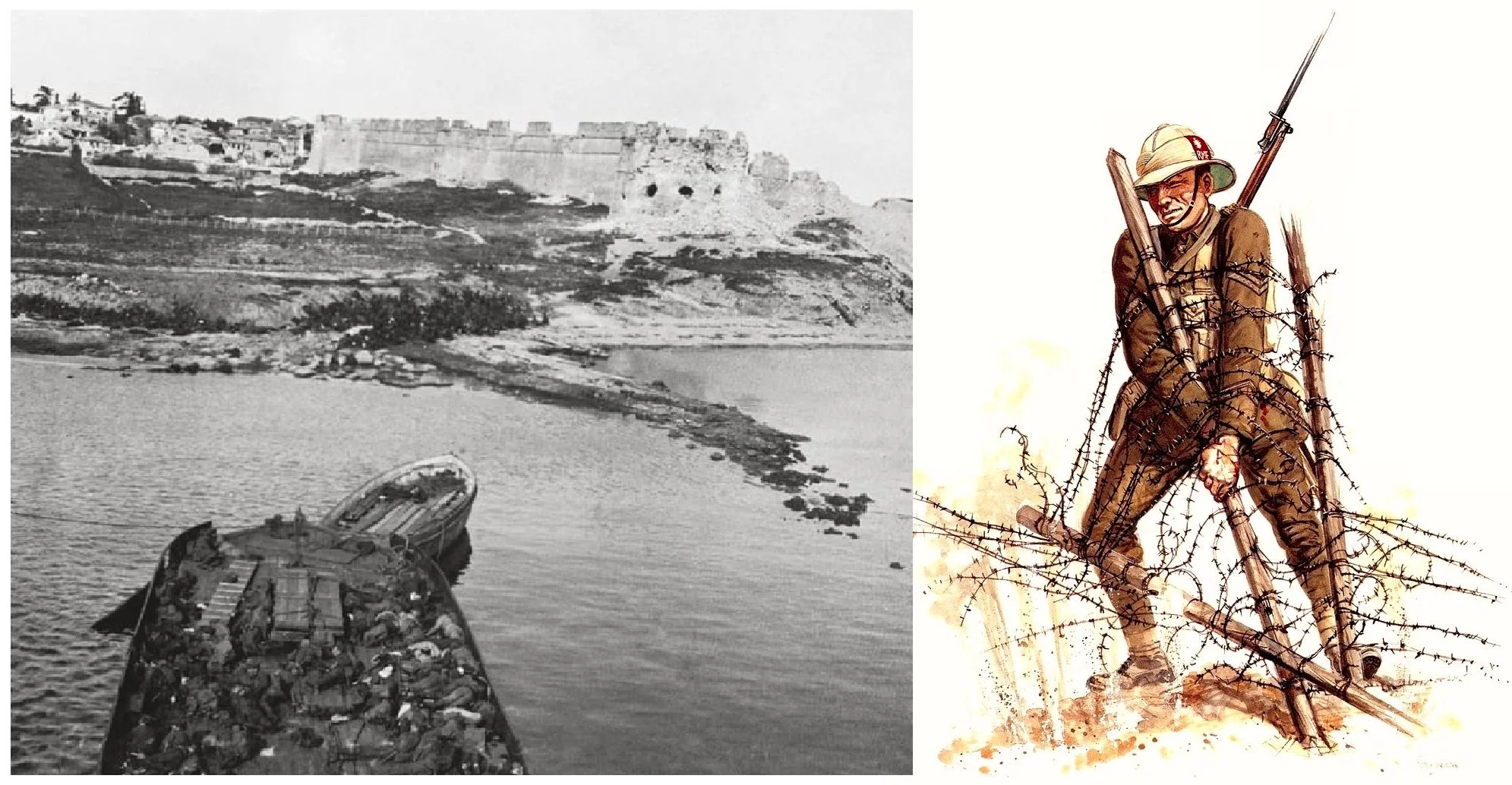
Photo copyright Australian War Memorial.
Illustration by Gerry Embleton, copyright Osprey Publishing.