How Cork won the Battle of Tsushima (not really)
I was asked to present a paper provisionally entitled ‘Cork and the Empire. This was earlier in the summer when ‘September’ was a distant concept like old age or the planet Neptune. And then suddenly it’s late August and I’m getting an email asking me for a more specific title and the clever part of my brain is still on its summer holidays. I never did get more specific, but the academic fight-or-flight instinct didn’t let me down either. I managed to slither out through the loophole offered by the general nature of the question: they never specified which empire.
What follows is the essence of the paper I gave.
Years ago, to justify all those books I’d been accumulating, I taught a course on naval history. It was one of those evening courses for an older audience – mostly retirement-age people who respect the spoken word more than they do the internet and want to play at being college students one night a week. They allow me to exercise my enthusiasms and I love them for it. On this one I pulled out all the stops. My particular triumph was the rise of Japan. Having spent weeks looking at the British and their rivals, I looked at what happened when an Asiatic power thought to play the English game. Japan, like England, controlled an archipelago conveniently adjacent to the continental mainland. Within fifty years of being introduced to western technology, they showed what could be done with the combination of geographical advantage and maritime ambition, with their own empire under way in Formosa, Korea, and Manchuria.
I have to say I played a blinder. Over the course of two hours I went from the broad Asiatic canvas to the smoke and spray of Tsushima Strait. At the end of it all, feeling more than a little pleased with myself, I asked if there were any questions.
Now Cork people will perfectly understand what happened next. And if you’re not from Cork, I think this will help you to understand the Cork attitude to the world at large.
One of my students – a well-dressed gentleman in late middle age – having considered the shifting balance of 19th-century Far Eastern history, and seeing the 20th-century Pacific opening up before him, said, ‘John, I’m surprised now that you didn’t mention those two brothers from Carrigaline.’
And that put me in my place.
It turns out there were these two brothers from Carrigaline.
To pay my due to them, to my county, and to history, I went and looked them up.
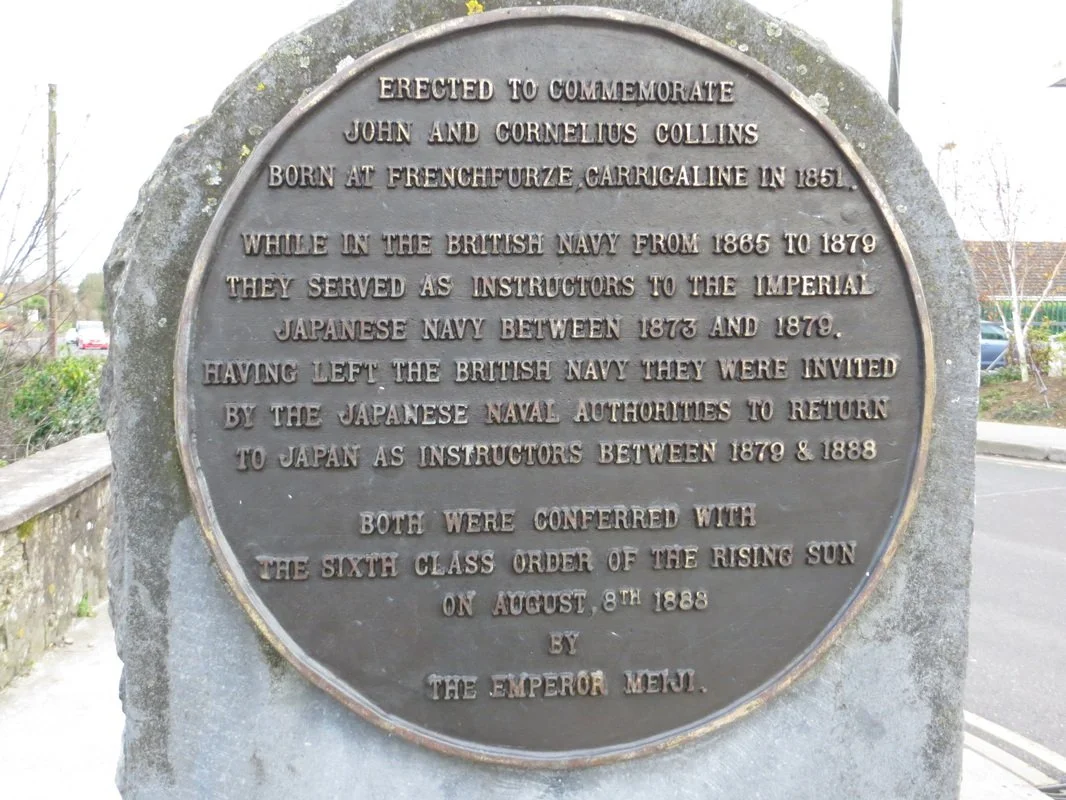
John and Cornelius Collins, twins, were born in 1851, in the wake of the Famine. Perhaps from a thirst for adventure, or more likely to help alleviate the family’s poverty, the two boys were sworn into the Royal Navy at the age of fourteen – so young that their enlistment forms show they’d only just cleared five feet in height, and so young that their father had to give his consent (while at the same time swearing that his sons were neither indentured apprentices nor had ever had fits).
The lads evolved into handy sailors but they might never have been distinguished from thousands of other able seamen if it hadn’t been for the Japanese need to build a modern navy.
In 1873 a British mission was invited to Japan as instructors. The Collins boys proved themselves good enough to be included. And so successful was their spell of duty at the Yokosuka Naval Base they signed on for another. Indeed, once they’d served out their time in the Royal Navy, they stayed with the Imperial Navy for several more years.
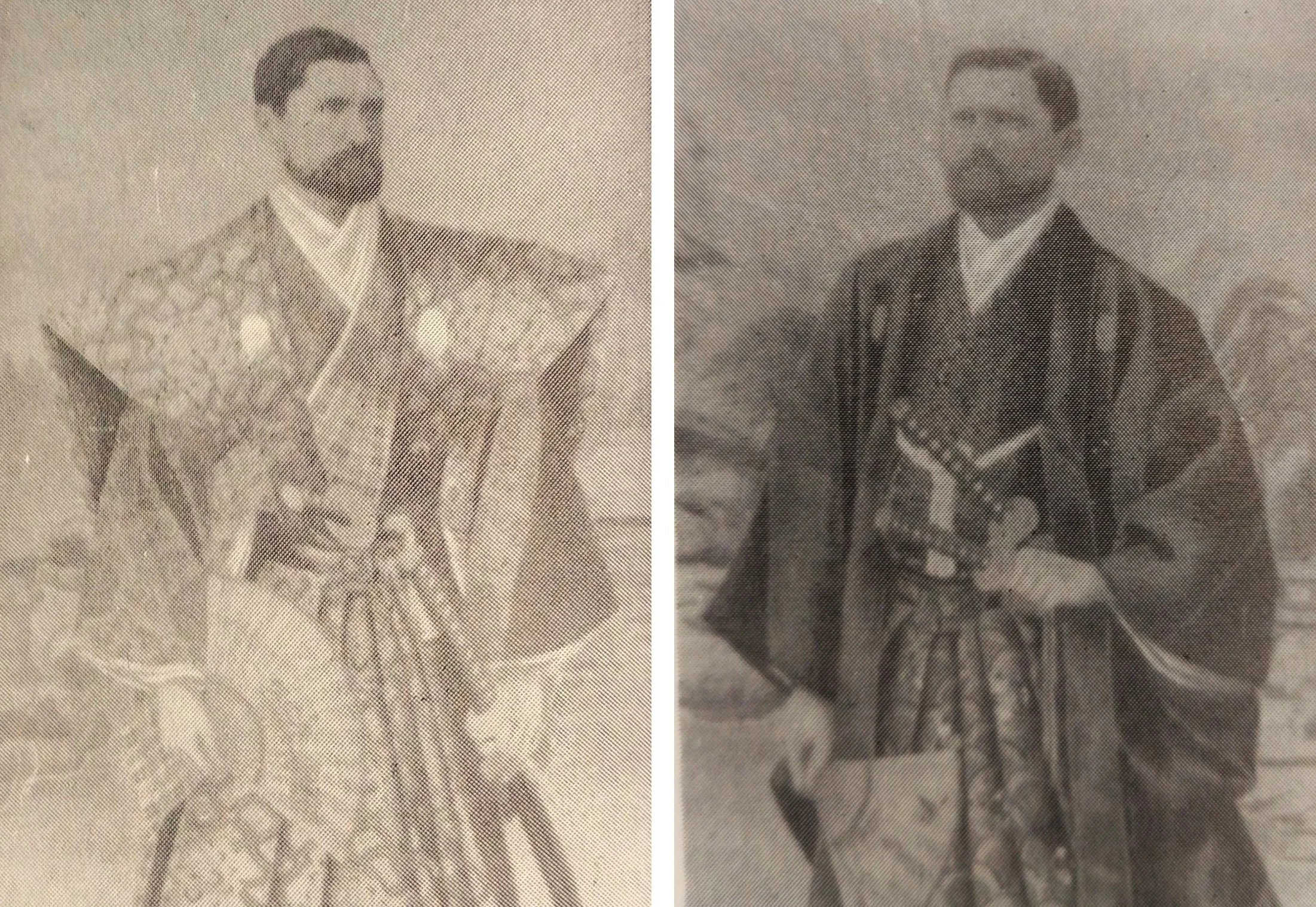
John (left) and Cornelius Collins (right), from Seán O’Mahony’s History and Folklore of Carrigaline. I only wish I could have seen the original pictures.
They came home in 1888 and took up farming near where they’d grown up. That might have been that if the Imperial Japanese Navy hadn’t paid a return visit in 1902. Technically the squadron comprising the battleship Asama and the cruiser Takasago were on this side of the world for the coronation of Edward VII, but try telling that to the Cork Examiner.
For a few August days, Cork played host to hundreds of Japanese sailors. Let me repeat that this was 1902, when the world was so much wider.
Instead of the drunken brawls in cat houses that might be the expected feature of a run ashore, the visitors enquired into commercial enterprises, spent their money on curios, and wondered aloud how Cork people could possibly tell each other apart. So much for the lower deck. For the officers it was all official receptions and glittering escorts. There were dignitaries and worthies. There was also one of the Collins brothers to show the Japanese officers around. I gather they sought him out particularly. And why not? They wouldn’t have known the Japanese consul from Adam, but John Collins had taught a generation of Imperial Navy their gunnery while Cornelius was learning them their bends and hitches.
There was the great exhibition on the Mardyke to visit; there was a game of croquet to watch (not to play, mark you, but just to watch); there was a celebratory dinner to be eaten. In recounting the latter, the paper makes much use of the word ‘hearty’. The reader can practically see the faces turning shinier with the choruses of ‘hear, hear’.
The Japanese squadron didn’t stay long. After the dinner they upped anchor – with fewer sore heads than were usual, one supposes – and that was that.
Were closer bonds forged between the Cork Chamber of Commerce and the Chrysanthemum Throne? Not that I know of.
The Japanese did leave behind a flag though and, because the Japanese naval ensign is the same red and white as the county colours, this particular flag was proudly waved at Cork GAA matches for generations to come.
Many might see the Rising Sun and think of Nanking or the Burma Railway. In Cork, its most evil association might be losing to Tipperary. As legacies of imperialism go, it could be a lot worse.