An Irishman first and last and all the time
It’s never as clear-cut as you’d think.
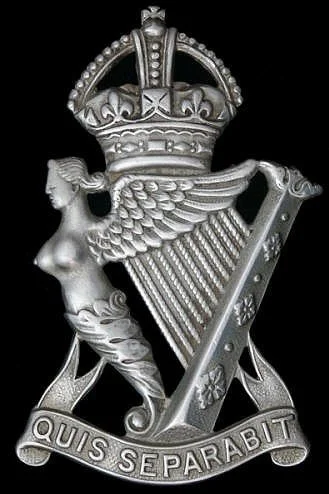
The off-the-peg nationalist view of Irish history has always been that the British army in Ireland was an army of occupation. Stretch that point just a little bit and that makes the Irishmen in British uniform misguided or, at worst, traitors. The Ireland to which they’d pledged their loyalty was a false Ireland. Their badge was the Gaelic harp surmounted by – and subservient to – the English crown.
But principles and loyalties are murky things. What’s in one man’s heart may not match with what’s in another man’s head, and neither of them line up with high-flown edicts and aspirations
And what might happen when push came to shove, as it so dramatically did in Easter week of 1916? The Germans – hailed in the Proclamation of the Republic as ‘gallant allies in Europe’ – hoped that the Irishmen fighting on the Western Front would throw the king’s shilling back in his face, but they were disappointed. A sign they hung on the wire in front of the Munster trenches did not provoke the Dirty Shirts to mutiny. ‘Irishmen!’ said the sign. ‘English guns are firing at your wifes[sic] and children!’ All that happened was that a Munster officer snuck out and removed the sign – and not because he felt under threat of lynching by his own rebellious men either.
That was pretty much the way of it. Tom Barry, later commanding an IRA flying column, but at the time serving with the artillery in Mesopotamia, wrote that the Easter Rising was his awakening, and that thereafter the world war took a distant second place to the tumult in his nationalist soul (I’m paraphrasing). The fact remains, however, that he remained a good little soldier of King George until the war was over.
But if you want to see the broad spectrum of the army’s feelings about 1916, just look at the 2nd Battalion of the Royal Irish Rifles.
A couple of years before the war, two brothers, John and Denis Lucy, ran away to join the army. Putting plenty of distance between themselves and their native Cork, they plumped for the Belfast-based Irish Rifles, and by the time the war broke out they were both junior NCOs. John was a sergeant waiting on a commission when the rebellion erupted in Dublin and he was sickened by the army’s heavy-handed reaction. ‘I would see the whole British Empire damned sooner than hear of an Irishman killed in his own country by any intruding stranger,’ he said, yet he accepted the king’s commission, served until he was invalided out, and even rejoined his old regiment (now the Royal Ulster Rifles) when the next war broke out.
If you want to read about John, he left an excellent memoir, There’s A Devil In The Drum. For Denis’s story, go and look at the war memorial on South Mall. The regimental motto, ‘Who will separate us?’ is particularly poignant in their case. Lance-Corporal Denis Lucy was killed on the retreat from Mons. The man who got him killed was a wayward company commander with a hare-brained notion to halt the German advance – single-handed if need be. He was another Corkman named Captain John Bowen-Colthurst and he was sent home as soon as his regiment could be decently rid of him. Barred from further promotion or deployment overseas, Bowen-Colthurst was in Dublin in Easter week. He did what any responsible officer might do and took out a patrol to see what was going on, but he quickly demonstrated why his own CO had been so eager to get rid of him, because Bowen-Colthurst shot a couple of inoffensive civilians in the street and arrested some more whom he subsequently had shot back in barracks.
He had declared himself ‘an Irishman first and last and all the time’, and this is how he dealt with suspected Irish nationalists. His court-martial found him guilty but insane.
Now compare Bowen-Colthurst’s position with that of Rifleman Julien Bailey, another casualty of the retreat from Mons. This is what the other extreme looks like.
Bailey was captured by the Germans and interned at Limburg POW camp where he was recruited by the soon-to-be-martyred-for-Ireland Seán MacDiarmada and Roger Casement into an Irish Brigade, which the Germans would somehow convey back to Ireland for the maximum discomfiture of Britain’s war effort. This ‘brigade’ never amounted to more than a handful of men, but even that was too much for the German navy to transport to Ireland. Rifleman, now Unteroffizier, Bailey was crammed into a U-Boat and landed on lonely Banna Strand alongside Roger Casement, where they were both promptly arrested. Casement agreed to co-operate if Bailey, whom he represented as no more than a patsy, was treated leniently. The crown prosecutor, with a fully co-operative knight of the realm-turned-traitor under his hand, was content to throw the small fry back, and Bailey was released from His Majesty’s custody. However, because conscription had come into force, the able-bodied Bailey was automatically drafted into His Majesty’s forces – which presented something of a problem, given that he was an NCO in the German army.
They solved the problem by shipping him off to Egypt where it seems he gave them no trouble at all before he disappeared from the record.
And there you have it: attitudes to the Easter Rising in a nutshell, with 2/RIR being the nutshell.
Bowen-Colthurst the bloody-handed loyalist; Bailey the nationalist dupe (if dupe he was); and Lucy just grumbling and getting on with things, much as I imagine most of us would do.
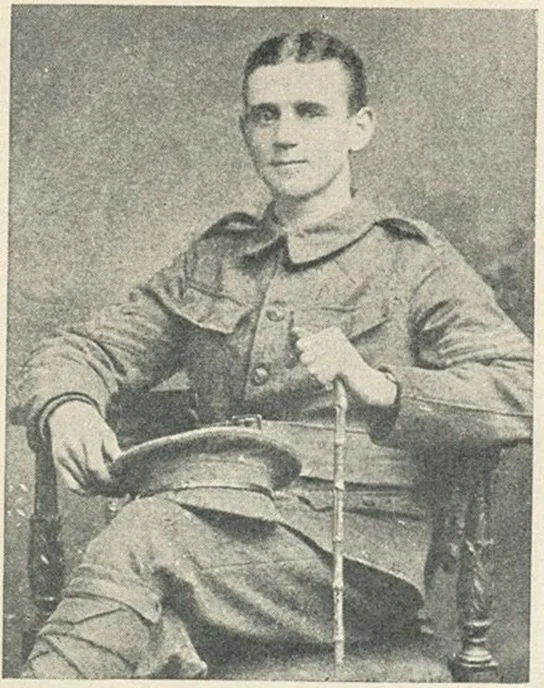
Sergeant Lucy, smiling for the camera despite it all.
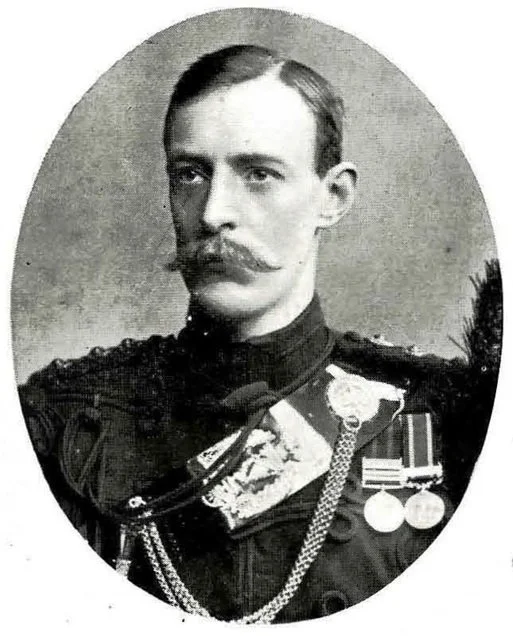
Captain Bowen-Colthurst, remembered by Lucy as, “A very religious man... always talking about duty, and a great Bible reader. Tall, sinewy, with a pale face and pale blue eyes... he came at us looking for blood.”
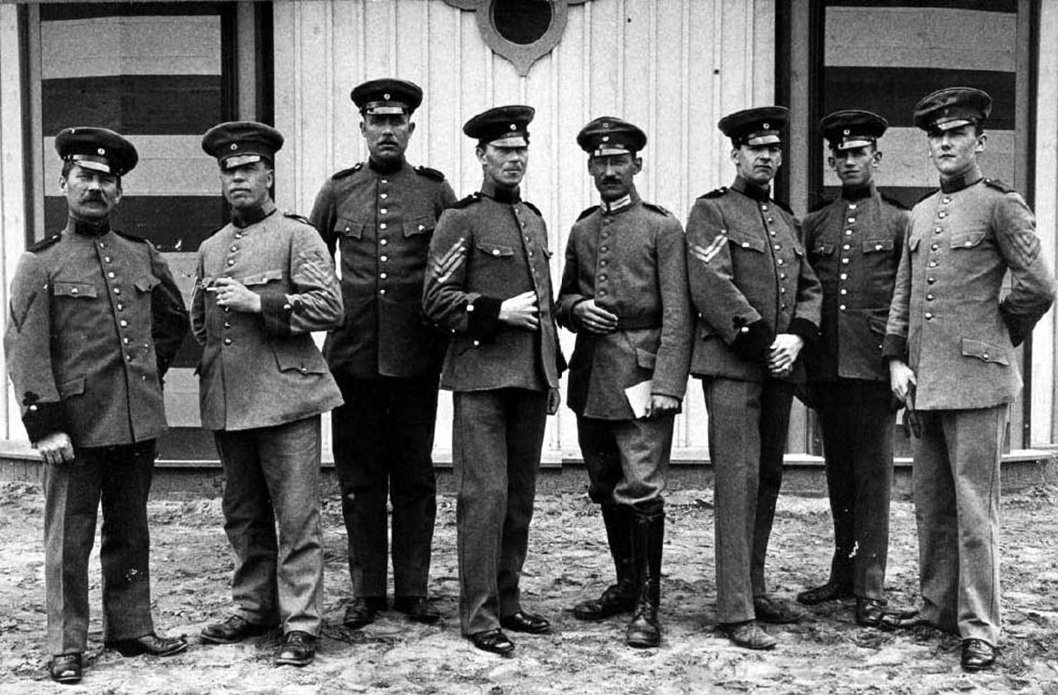
Unteroffizier Bailey, fourth from the left (I think), with almost as much of the German ‘Irish Brigade’ as could be found to enlist.