Whose War Is It Anyway?
Don’t tell anyone, but I like poetry. Nothing too hifalutin, mind. My introduction to the finer aspects of English literature came by way of forthright, uncomplicated men whose method of teaching poetic appreciation was to make us memorise the poem and to hit us when we didn’t.
So middle-brow and memorable is the way I go still.
But while confessing I like poetry might be something I can get away with in middle age, it wasn’t going to wash in my teens. Back then, it wasn’t something I’d have owned up to even to myself.
You had to admit though that the War Poets were pretty cool. I mean, for a start there was a recognisable literary body known as War Poets. Maybe not as good as warplanes or warships, but these lads wore khaki instead of frilly shirts, wrote about poison gas more than daffodils, and tended to die from shrapnel wounds rather than anything more sissily romantic like consumption.
Our school poetry books dated from the late sixties and early seventies when the anti-war movement was strong. Most anthologies of the time were mid-twentieth century, when glorifying slaughter wasn’t going to win anyone many customers. Point being, you didn’t have to dig very far into 20th century poetry before your spade struck Wilfred Owen.
On the off chance you’re not familiar with him, he was a junior officer in the infantry who was invalided out for shell shock, recovered to the extent that he returned to duty, was decorated for bravery, and died in the last week of the war while leading his platoon against the German defences on the Sambre-Oise canal. His parents received notification of his death as the church bells were ringing out the victory. His signature work is ‘Anthem for Doomed Youth’, which pretty much sets the tone of what he and the other war poets are famous for. It also informs our perspective on the war. Find me any writing since the 1920s that doesn’t lean on the doomed youth and the lost generation and I’ll give you a prize.
The war was horrible. These tragic young men said so, and they should know.
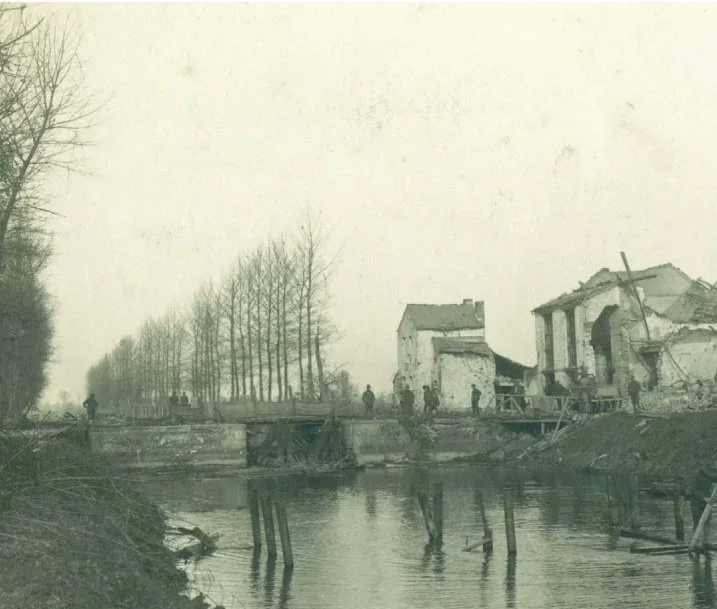
The Sambre-Meuse canal crossing: the specific objective for which Owen died.
But it hadn’t always been that way. These boys arrived late. Owen didn’t get to the front until the beginning of 1917, and I’m inclined to doubt that he was dwelling on the misery and futility before then. Neither he nor any of the other War Poets could have exercised any influence on anyone’s viewpoint when the men first marched off. The poets’ perspective – our perspective – is post-war, or late-war at the very least. The war that we remember isn’t the war that anybody saw at the start. Their perception had been coloured by someone a lot more positive.
No, if you want to look for a literary influence on the early war, then Rudyard Kipling is your only man.
Kipling wasn’t someone we did in school. Far too imperialist. But you can’t grow up in the English-speaking world without knowing a few bits and bobs – even now. Back when he was the Poet of the Empire, of course, everyone knew him. His poems were set to music, for God’s sake. The men who marched off in 1914 – the lads who might not have been so well-versed in verse and who naturally wouldn’t have known the likes of Wilfred Owen if he’d bit them – they knew Kipling if they knew anyone. They were positively inspired by him. ‘You’ll be a Man, my son,’ and all that.
So what might have ended as Owen’s war – poetically at least – started as Kipling’s.
Me? I discovered Kipling when I should have been doing something else, years ago. With their cholera and booze and bullet wounds, the poems had a rougher edge and a harder core that I’d been expecting. Kipling’s characters aren’t gently-reared young men, stunned by the mass slaughter of the trenches. They’re a less refined breed altogether, who fought their fights out of dogged pride and hard-learned discipline.
So when I sat down to write about the First World War, I wrote about Kipling’s war instead of Owen’s war.
My Dirty Shirts aren’t so much the boys who were inspired by Kipling: rather they’re the ones who’d inspired him in the first place. They’re the men of the Barrack-Room Ballads. They’re Private Mulvaney and Troop Sergeant-Major O’Kelly. They’re the sort to serve their time in Injia’s sunny clime, and all for a shillin’ a day.
The Old Contemptibles were no doomed youth. Not many of them might have been still standing by the time the summer of 1915 rolled around, but they weren’t a lost generation.
If they’d got around to calling it the Great War, they’d have called it as much with a sardonic sneer or grim pride, depending.
And they’d have laughed you out of court if you’d told them that one of them might be one day buried anonymously, but with kingly pomp, in Westminster Abbey.
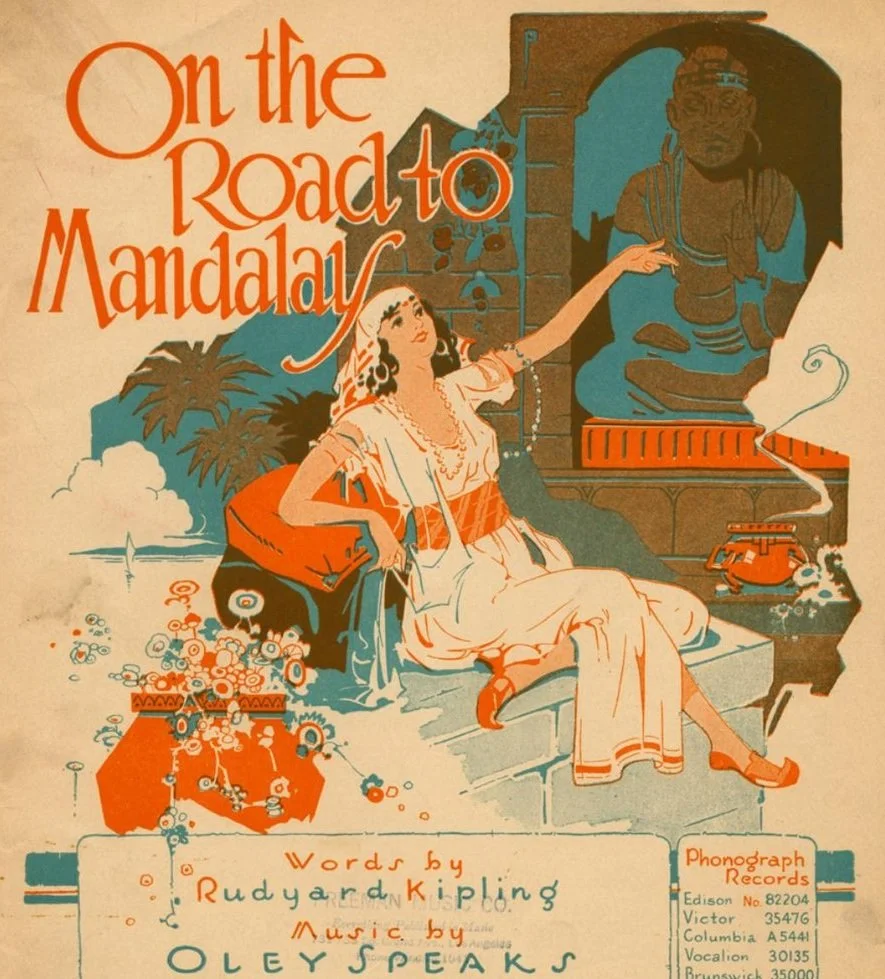
Halfway to being a recruiting poster for the Old Contemptibles.