Perspectives in blue
I spent the back half of Fourth Class drawing fellas getting killed. Hundreds and hundreds of them. So many that I just drew little upright lines to stand in for men. My classmates asked me if I were drawing blades of grass. I can understand the confusion, seeing as the ‘grass’ was liberally interspersed with what might have been mistaken for bushes. Those happened to be explosions. There wasn’t much else in these drawings beyond what the eye of faith might just have recognised as ruins. What I was drawing, of course, was the fighting for Fort Vaux in May and June of 1916. What I was drawing was Charley’s War, written by Pat Mills, drawn by Joe Colquhoun, and recently discovered by me.
Charley’s War appeared in Battle, one the last of the British boys’ comics, and it also belonged to the grand tradition of war stories called ‘So-and-so’s War’ which gave it just a little more gravity than the more lurid, action-packed, two-fisted offerings. The Charley of the title was a plucky cockney lad who bore witness to the horrors of the trenches while, where necessary, biffing the beastly Boche – because only a fool alienates his audience by drifting too far from what they’re here for.
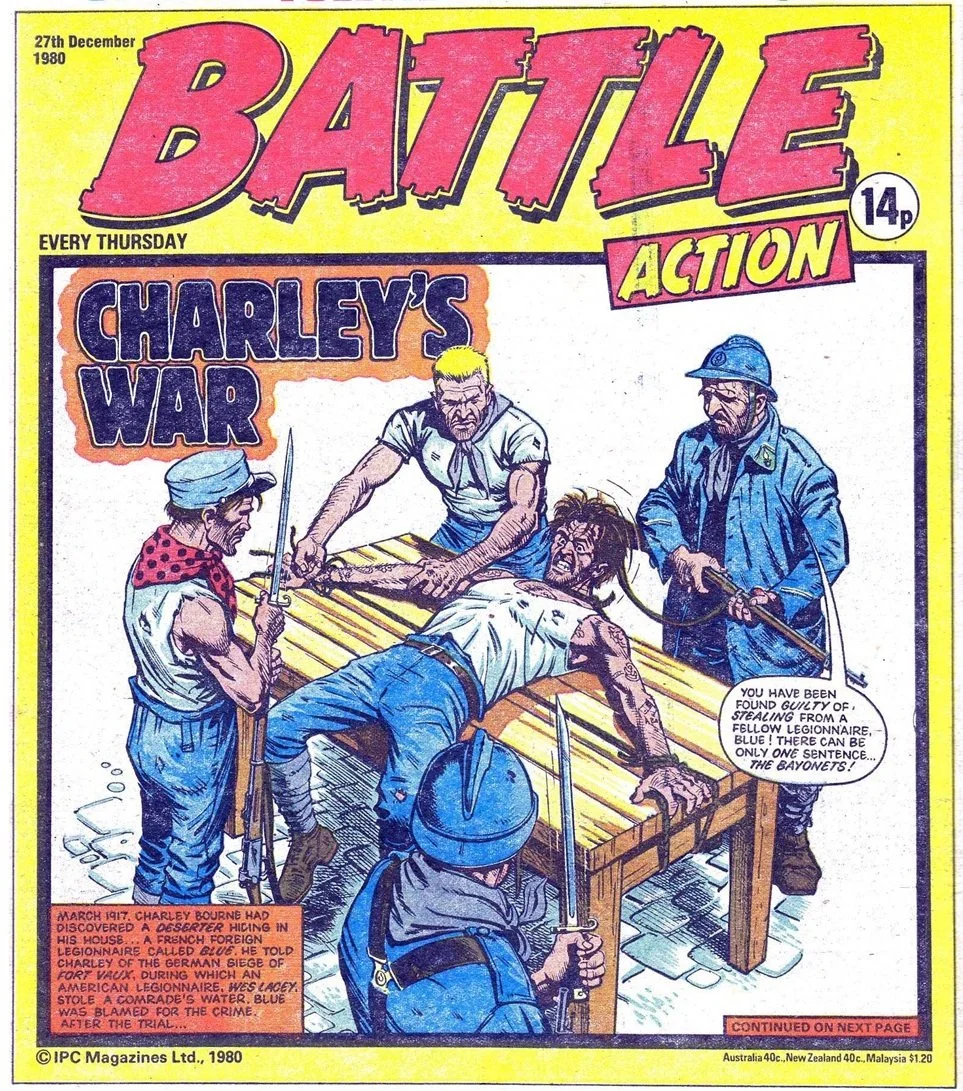
Charley’s War, written by Pat Mills, drawn by Joe Colquhoun
When I first had a look in I had no opinion about Charley one way or the other because, as luck would have it, he was obscured behind a gas mask for the whole of that episode. When I returned a few months later, Charley wasn’t even the protagonist of his own strip. The adventurous writer had decided to tell a lengthy story within a story about the travails of a Foreign Legionnaire at Verdun. The episode that had me so enthralled that I spent weeks recreating it over and over in my copybooks was the siege of Fort Vaux.
Actual history? Several hundred French troops held on to a battered concrete strongpoint while half the German army tried to fight their way in with flame throwers and demolition charges and all the artillery in the world, and you get the impression that the French would be holding on still if they hadn’t run out of water.
I learned in later years that the background material for the fictional version had been gleaned from Alistair Horne’s The Price of Glory, and all credit to Alistair Horne for drama and human suffering, but he couldn’t match the slam-bang sensationalism that was the life-blood of boys’ war comics.
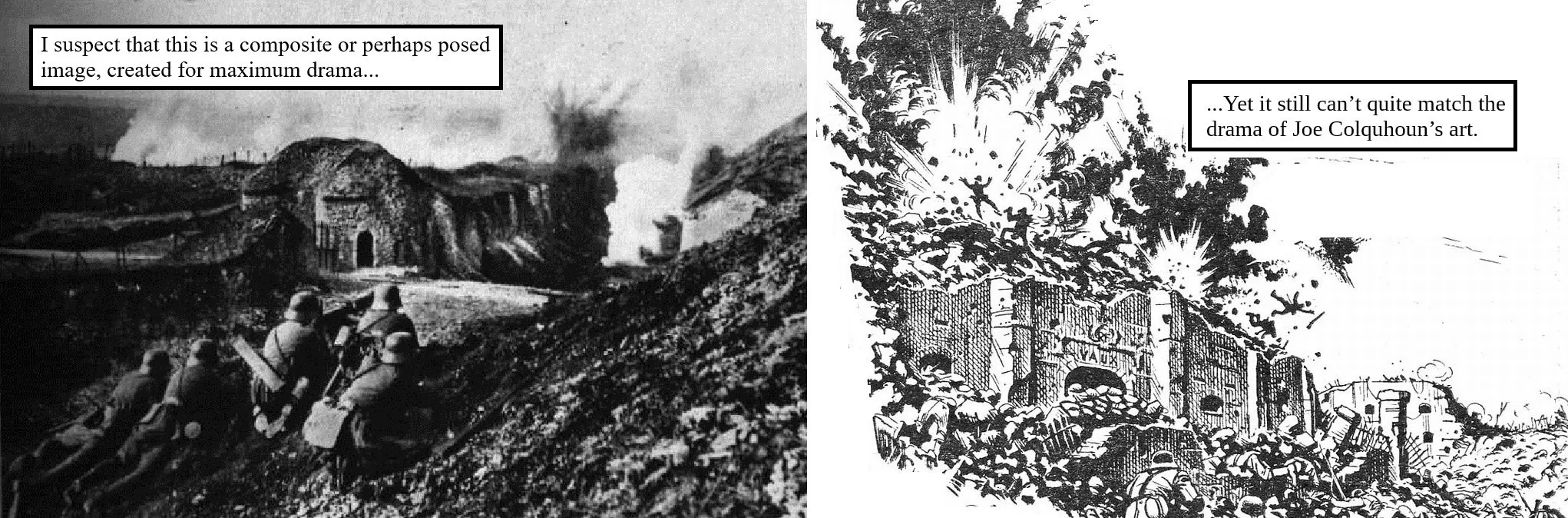
Pictures copyright Rebellion Publishing
The comics version put our hero and his mates right there in the sweating tunnels, breathing chemical smoke, fighting hand-to-hand, and all the while racked with thirst. That last bit lent a Beau Geste vibe to the Foreign Legion story, in case we were missing one, but instead of the theft of a fabulous jewel by a clean-cut English gentleman to drive the plot along, here we have the apparent theft of about a litre of water by a tattooed English guttersnipe in need of a haircut. (Do I need to mention that our hero here is innocent?) His punishment isn’t something that I recall reading in Beau Geste, but I certainly saw it in a Hollywood adaptation: the thief is tied down while a bayonet is driven through each of his thieving hands. Yikes.
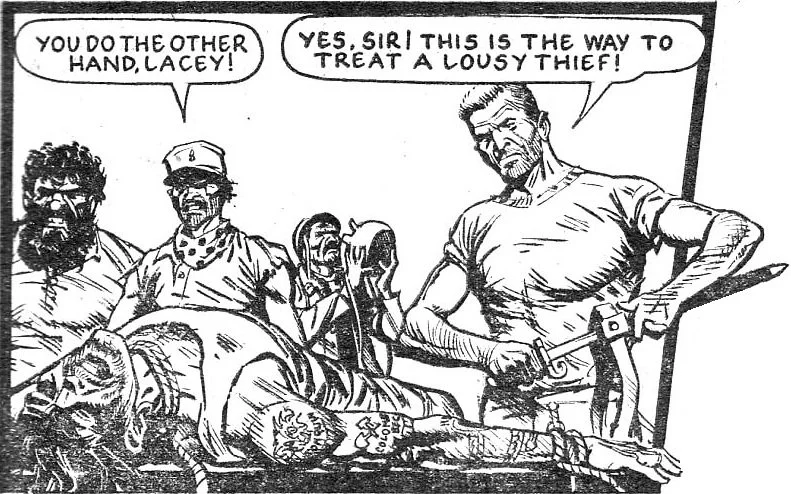
Picture copyright Rebellion Publishing
And to think that only a few months before I’d been happily reading the Beano. It’s quite a step from a slippering to a barrack room crucifixion.
What’s my point in all of this – besides the obvious one of parading my influences, I mean?
Well, in the field of British boys’ comics, in which nine to ten tenths of all stories featured plucky Brits winning the war all by themselves, this French interlude made an impression. I understood, through the medium of four-colour separation, that the war on the Western Front was fought in horizon bleu as much as khaki. That impression remained as my understanding grew and my thoughts matured.
When – forty years after my captivation by Charley’s War – I found myself lecturing on the First World War, I was particular enough to emphasise that this was a war between France and Germany. Yes, the British were there from the off, but they didn’t become anything like equal partners with the French until after the Somme.
And teaching aside, while the Foreign Legion doesn’t feature in the Dirty Shirt books, the attentive reader will notice a certain multinational flavour in the incidental details. The German-named Polish veteran of the Russian army in The World In A Sandbag and the battered West African infantry in A Green Bough are just two distant salutes to this being a world war. The American tourist in an Irish regiment of the British army is more obvious.
In Charley’s War the French legionnaire episode ran its course and Charley returned to the forefront of his own story. By the time my summer holidays rolled around he had been sent to the Ypres Salient. Still engrossed in it all, I spent much of Fifth Class drawing mud.