A Study in Khaki
Note: This was just going to be a short Facebook post, but my professional page has been suspended on the grounds that it was deemed to be ‘inauthentic’— which I thought was a bit rich coming from an artificial intelligence. My friends, the War Against The Machines is already being fought and we are losing steadily…
My author’s copies of Household Gods and the new editions of the previous books arrived. I dropped by the office to see what vexatious paperwork might have been piling up for me since before Christmas, and there they were. Has any of us yet lost the thrill of finding brown parcels addressed to us? Will we ever?
I did exactly what you would do on unwrapping them: I spread them out on the floor and I gloated. After I’d done all the hand-rubbing and self-satisfied cackling, I recorded the moment for the sake of publicity.
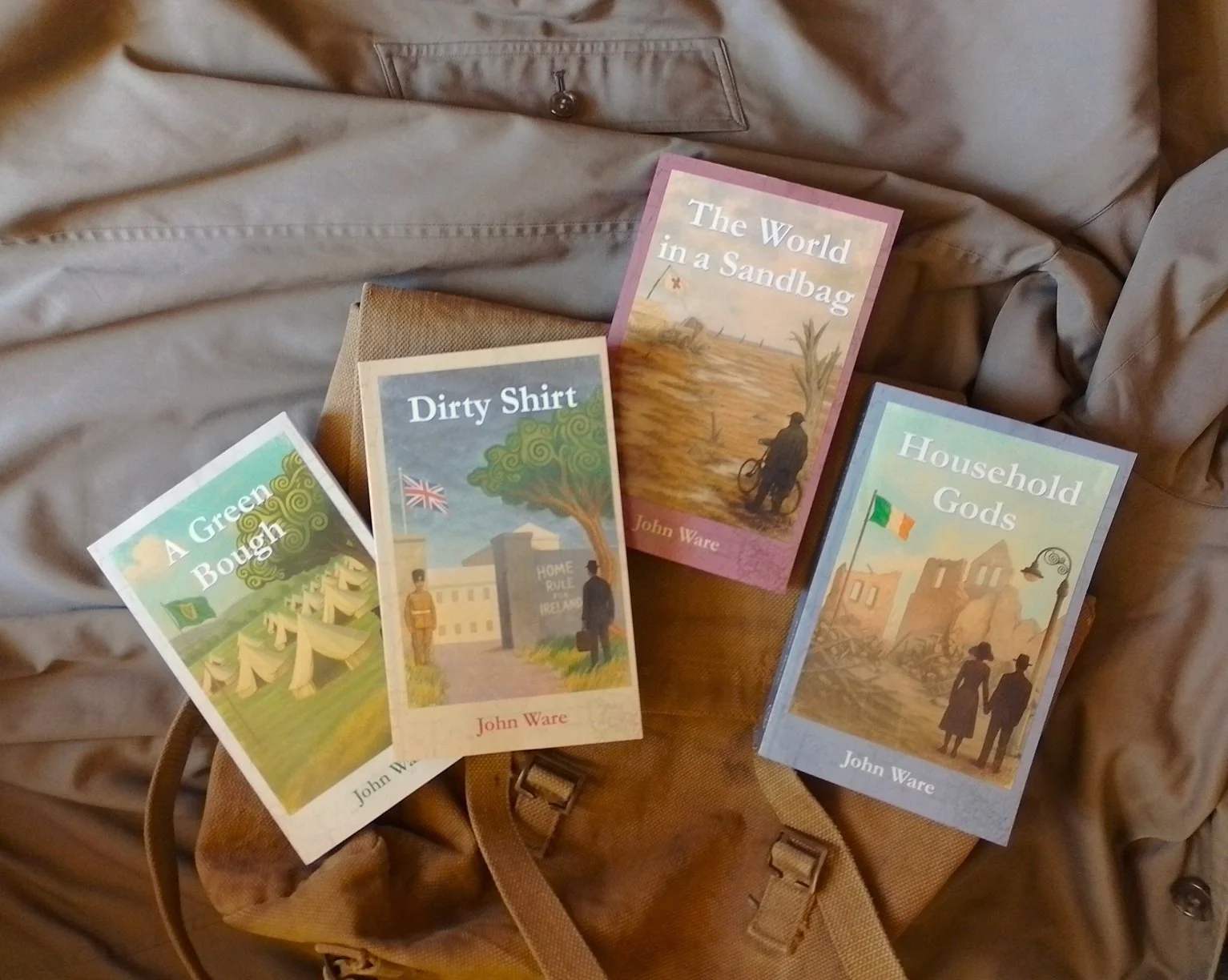
My study was carpeted more than twenty years ago when I had no money and no taste in carpets. I still can’t lay claim to either of those things, but I knew that the carpet would be better off hidden and that the books deserved a backdrop redolent of their theme. There it is. A study in khaki.
The khaki with the buttons is a raincoat of the exact type advertised for the well-dressed officer of the First World War. I doubt if the example pictured dates from then, but it is of great age and shows it. It’s also oversized, but I hold onto it because it would have been too much hassle to send it back to its original owner in Poland.
The khaki with the buckles is – as the educated eye can readily ascertain – webbing of the sort issued to the British military. It should by rights be a 1908-pattern pack, but like all those anachronistic props and costumes that show up in underfunded or ill-informed screen productions to affront the historical nit-picker’s eye, it’s not. Just as they might try to palm off a Lee-Enfield No. 4 rifle as a Mk. III, I created my WW1 tableau with a 1937-pattern small pack. Why not? I was in a hurry and I own two of the things.
I am not, I hasten to point out, a collector of militaria. I acquired the first of these two examples of vintage kit the same way everyone did. It was my school bag. I bought the second when I was in college, after the first had got frayed to hell and gone. (Frayed or not, it’s held on to, even if it is stuffed somewhere under my sink. The other one (pictured) still sees semi-regular use.)
A 1937 small pack was what seemingly everyone in my town had in the mid-eighties.
I believe that soldiers in the First World War, too encumbered by their large packs, took to wearing their 1908 haversacks as fighting-order packs, and the arrangement was formalised twenty years later when the 1908 webbing equipment was updated. The Irish Defence Forces took to using the stuff and, in the way of peacetime armies with hand-me-down gear, held onto it for forty years until no other army would want it. This, I suppose, was how a shop on Cornmarket Street acquired a job-lot of small packs in army khaki and navy/air force pale blue and flogged them as school bags. That shop must have been just one of many. Did the packs sell? Hot cakes weren’t in it.
They weren’t waterproof but they were durable. The fabric also served as a canvas – quite literally – for the creative outlets of teenage kids. Give me a biro and bit of webbing in geography class, circa 1985, and at the very least I’d give you a fervent tribute to a favourite band.
When you ran out of webbing you could go to town on the sleeve of your Bundeswehr parka. I didn’t own one of those, but the guy who sat behind me in second year did, and it was a blue-ink-on-olive-drab celebration of U2. I suppose these days the kids would just get tattoos.
Whatever ink I put on my bag is long washed out. I wonder if the manufacturer’s stamp is even visible anymore. It was dated 1942. I always liked that I was humping my schoolbooks around in an army pack that was more than forty years old. I imagine I’d have been tickled to know that it’d still be carrying things another forty years farther on.
You have to wonder though. I’m sure that whoever approved the 1937 design would have been gratified to know how long it would last, just as I’m sure that that whoever produced the original 1908 pattern would have been chuffed by its durability, but that’s not what I’m driving at. Just consider the scale of militarisation in the 20th century whereby, forty years after the shooting stops, there’s still so much military clobber lying around that a generation of Irish schoolkids can be outfitted.