Dressing Up
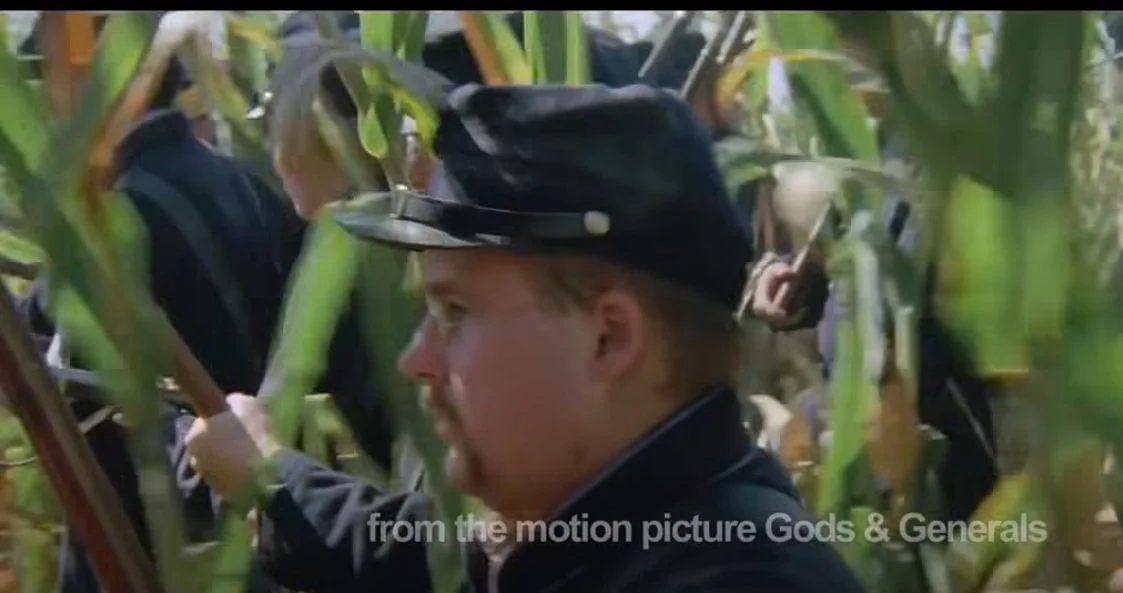
I caught a clip of the film Gods & Generals the other day and, if I didn’t know that my DVD copy had gone wonky, I’d have been tempted to dig it out. It’s essentially the first two years of the American Civil War with the story centred on Stonewall Jackson.
The film’s not the historical epic that it aims to be, but it’s not a bad flick either – not if you like to watch soldiers in period costume marching to and fro or actors in false beards playing historical figures you’re pleased with yourself to recognise.
To detract from the verisimilitude, the actors tend to be too old for the roles. And the extras? The extras tend to be fat and short-sighted. Sorry. Let me say instead that the extras – for all the historical accuracy of their dress and bearing – rarely possess the physique of the men they’re portraying.
The armies that clashed at the Antietam Creek were made up of men who’d done a lot of hard marching on short commons. I can’t imagine that the older or portlier ones had made it that far, or that quite so many of them were wearing spectacles. And I’ll bet that they weren’t nearly so particular over the correctness of their dress as their imitators of a later age. But these are mean-spirited complaints. I admire re-enactors. I admire their commitment to authenticity. I feel that they help keep the makers of historical drama honest.
Of course there are those who take it a bit too seriously. I’ve heard of Polish Vikings showing up at an exhibition in Dublin, seemingly dead-set on reversing the decision of the Battle of Clontarf.* But as a visitor watching them told me, it was one hell of an insight into how close combat in olden days went down. And there’s the worth of re-enactment. We learn by doing – or least by watching others do the doing. How well could a man move in medieval war gear? How long could he swing a weapon around before the battle degenerated into competitive wheezing? The re-enactors will do their damnedest to find out by recreating the circumstances as far as their research, imagination and budget will allow.
This month, to celebrate the 160th anniversary of Königgrätz, it seems that the re-enactors are finding out what it’s like to march about in big woollen coats in this weather. You have to hand it to them.
Of course, we know what the Austrian and Prussian soldiers wore in 1866, and we know what they carried, so the re-enacted experience is personal rather than educational. Consider though, the men who kit themselves out as Roman legionaries. We might think we know what the originals were like from old sculptures, but it’s the re-enactors who are finding out just how the weathered stone translates into cloth and metal. More specifically, they’re the ones who feel the heft and constriction of it when you try walking around in it all day. This is immersive experimental archaeology. That little apron of studded leather straps that hang down from the front of the belt? How much of that is groin protection and how much decoration? The classicists can argue but the re-enactor will tell you without hesitation that it’s a hindrance when marching. He’ll also tell you how long you can hold a shield up in front of you and how far you can reasonably throw a pilum – all things that are useful when interpreting the textual and material evidence that make up the more respectable basis of historical research.
Granted, you might want to treat the re-enactor’s assurances with caution. After all, a man who spends his spare time in his shed making a full harness of lorica segmentata out of sheet metal, which he then chooses to wear in public over a short red skirt, is not usually a man afflicted with doubt.
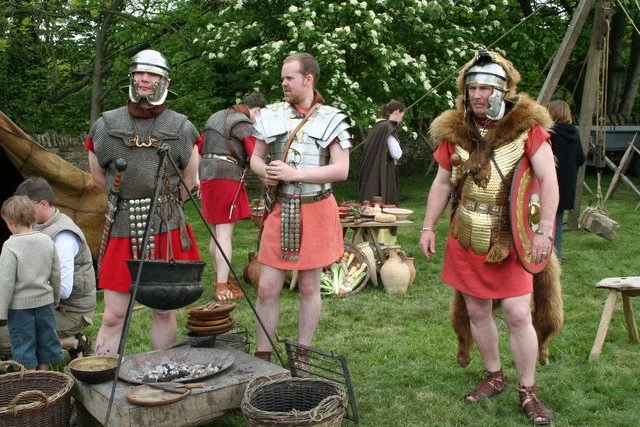
The Ermine Street Guard, giving it some leg. (photo by Bob Heron)
Yes, that sureness bothers me. I’m all for an educational day out in period costume, but I like to see some latitude of interpretation too, or at least some acknowledgement that we don’t know everything for a fact. Come on – there’s something uncomfortable about armed men insisting that their way is the right way. I suppose it’s harmless enough if they’re getting all dogmatic while playing at being Cavaliers and Roundheads, but hard-line certainty isn’t something I want to see in a re-enactment society with a name like Kampfgruppe Süd.**
Keep it clean, boys, and remember: your side lost.
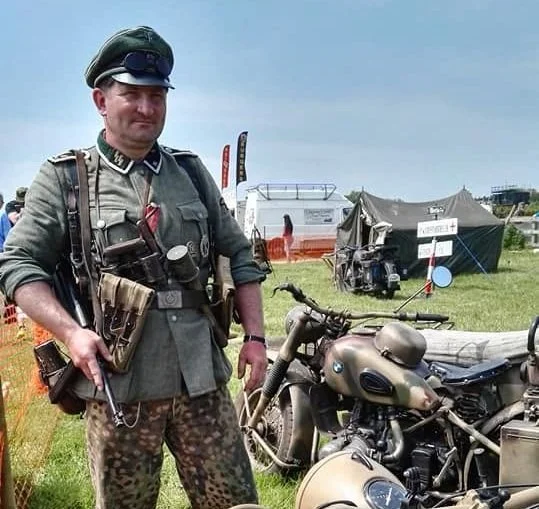
‘I’ve just got the sort of eyes that are set off by feldgrau.’ (from the Kampfgruppe Sud Facebook page)
*Is it re-enactors in general or Polish ones in particular? A Polish colleague tells me of dangerous enthusiasts who show up at her uncle’s farm every year with horses and lances and machine-guns to re-enact the 1920 Battle of Warsaw, only it always turns out to be a hopelessly one-sided exercise since no one wants to play a Bolshevik.
**To be fair to them, their Facebook page says they’re a group ‘specialising in the restoration and exhibition of original German WW2 vehichles [sic] and equipment’. No mention anywhere of Lebensraum. Also, they omit the umlaut in Süd, so they’re not that authentic – thank God.